
ATEX Certification:
The European Legal Mandate
If you are operating or selling equipment within the European Economic Area (EEA), ATEX is not optional—it is a legal requirement. Derived from the French Appareils destinés à être utilisés en ATmosphères EXplosibles, ATEX ensures a high level of protection for both the equipment being used and the workers operating in volatile environments.
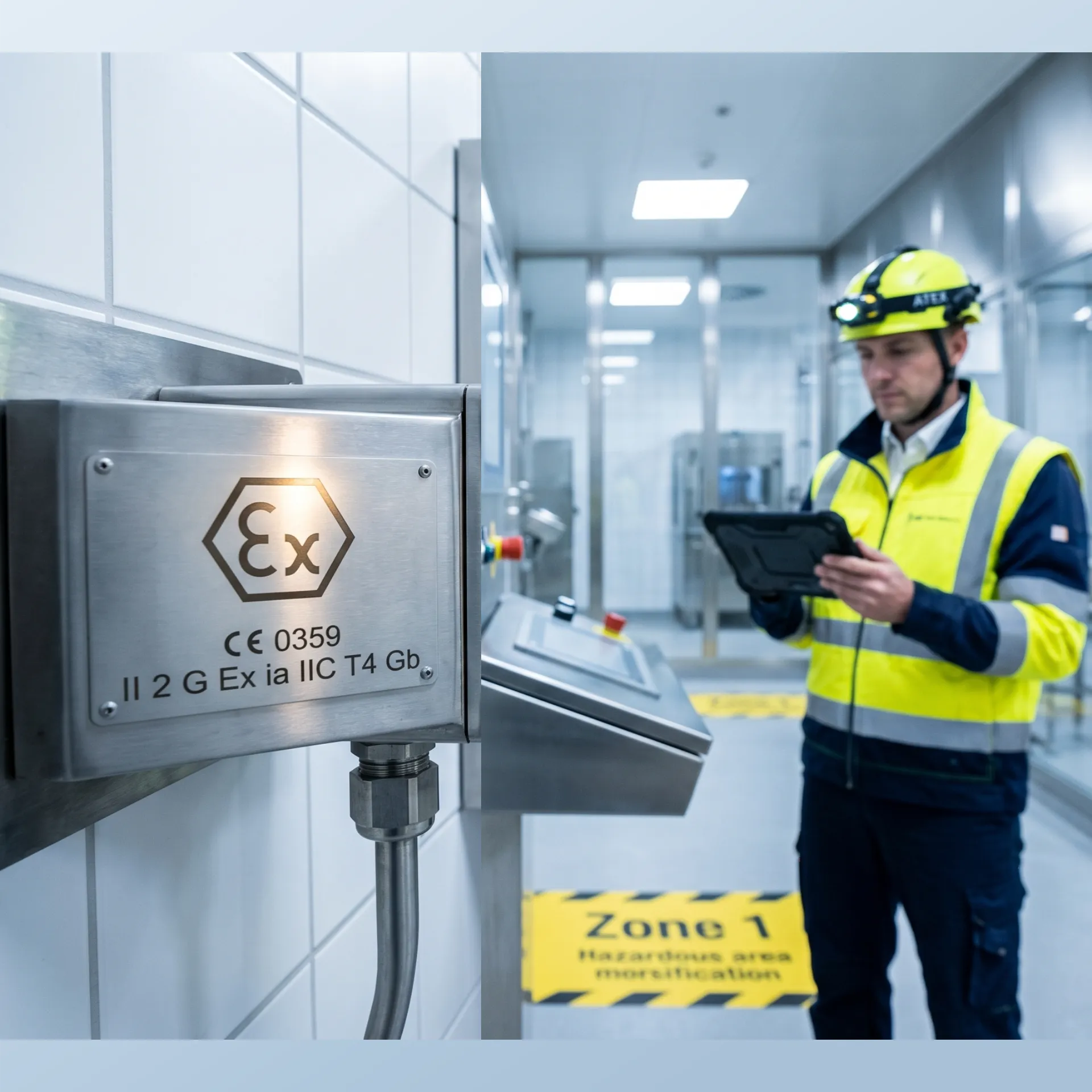
The Role of ATEX in Global Industry
Unlike the North American system, which is largely driven by third-party testing labs (NRTLs) and standards like the NEC, ATEX is a set of EU Directives. It places a dual responsibility on both the person making the equipment and the person running the facility.
There are two distinct ATEX directives that every professional must know:
- ATEX 114 (Directive 2014/34/EU): Aimed at Manufacturers. This covers the design and sale of equipment intended for use in potentially explosive atmospheres.
- ATEX 153 (Directive 1999/92/EC): Aimed at Employers/Users. This focuses on the health and safety of workers, requiring employers to classify their facility into “Zones” and ensure all equipment is fit for purpose.
Expert Insight: A common mistake for beginners is assuming an ATEX-certified product is “safe for all of Europe.” While the hardware certification is harmonized, the application of that hardware must still comply with the specific “DSEAR” (Dangerous Substances and Explosive Atmospheres Regulations) or local safety laws of the specific country where the work is being performed.
Understanding ATEX Groups and Categories
ATEX simplifies the world into two main Groups and several Categories. This is the first thing an inspector will look for on your equipment label.
| GROUP | ENVIRONMENT | CATEGORY | PROTECTION LEVEL |
| Group I | Mining (Methane/Coal Dust) | M1 / M2 | Very High to High protection for underground mines. |
| Group II | Surface Industries (Refineries, Labs, Hangars) | 1, 2, or 3 | 1 (Very High/Zone 0), 2 (High/Zone 1), 3 (Normal/Zone 2). |
The Zone Mapping:
- Category 1: Required for Zone 0 (Gas) or Zone 20 (Dust) – Explosive atmosphere is present continuously.
- Category 2: Required for Zone 1 (Gas) or Zone 21 (Dust) – Explosive atmosphere is likely to occur in normal operation.
- Category 3: Required for Zone 2 (Gas) or Zone 22 (Dust) – Explosive atmosphere is unlikely to occur, or only for short periods.
Decoding the ATEX Marking
The most recognizable part of an ATEX certification is the “Ex” hexagon. However, the string of characters following it tells the real story of the device’s capability.
- The Hexagon: The distinctive “Ex” symbol in a hexagon indicates the product meets European harmonized standards.
- Equipment Group & Category: e.g., II 2 G. (Group II, Category 2, Gas environment).
- Protection Type: e.g., Ex db (Flameproof) or Ex ia (Intrinsically Safe).
- Gas/Dust Group: e.g., IIC (Hydrogen/Acetylene) or IIIC (Conductive Dust).
- Temperature Class: e.g., T4 (Max surface temp 135°C).
Why this matters legally: If your device is marked for Category 3 (Zone 2) but you install it in a Category 2 (Zone 1) area, you are in direct violation of the ATEX 153 directive, which can lead to immediate facility shutdown or heavy legal penalties in the event of an incident.
Official ATEX Resources & Verification
To stay compliant, professionals use these official EU-maintained databases and guides:
- EU ATEX Directive Homepage: The primary source for the latest legislative updates and guidance documents (the “ATEX Guidelines”).
- NANDO Database (Notified Bodies): The official list of “Notified Bodies”—the authorized organizations (like Intertek, SGS, or DEKRA) permitted to issue ATEX certificates.
- ATEX Protective Systems Guidance: A deep dive into the technical requirements for the CE marking and the Declaration of Conformity (DoC).
